

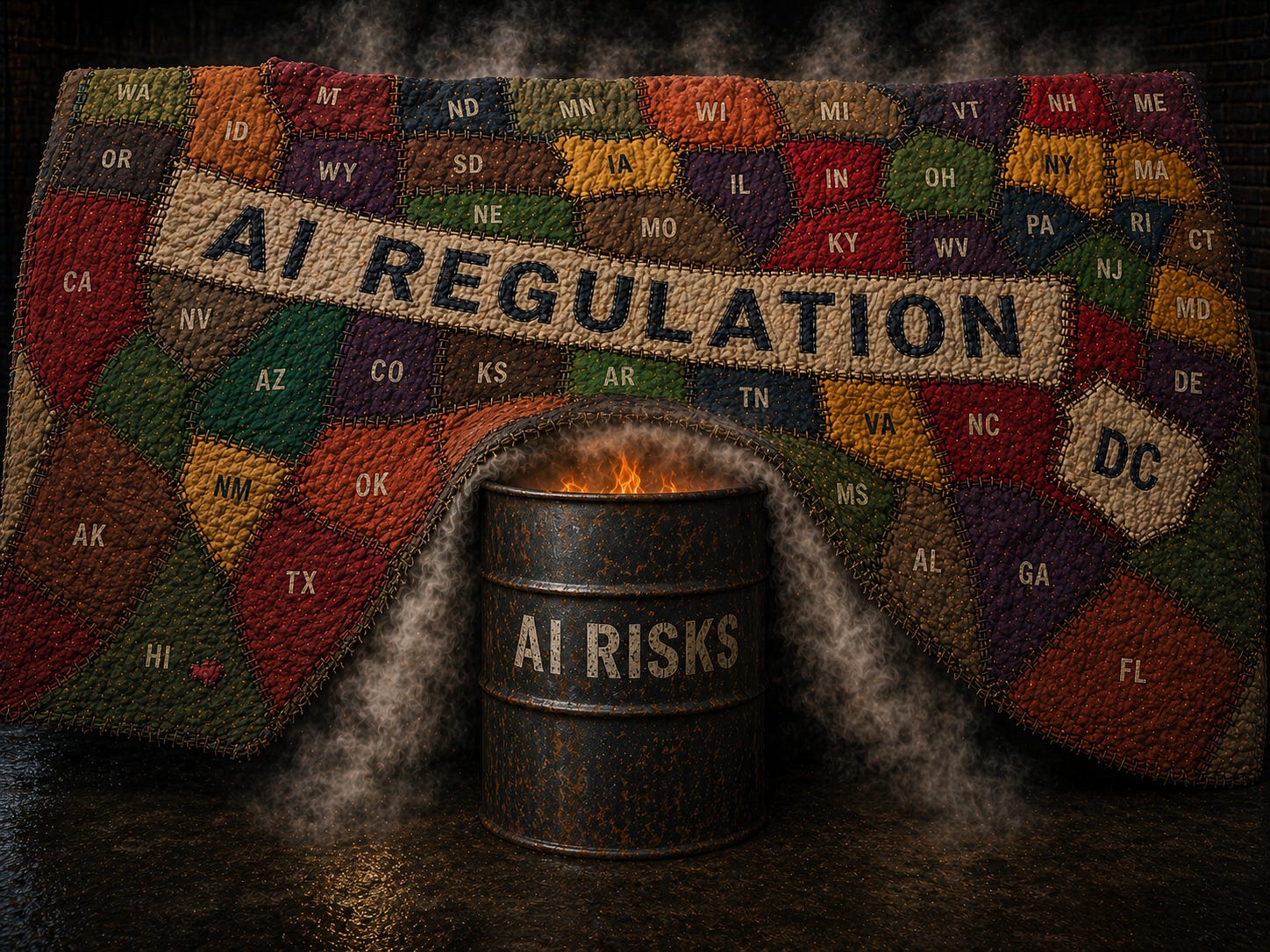
Consider a few of the big AI risks: violating privacy, taking jobs, and destroying the world. Here’s what Sam Altman (CEO, OpenAI) and Dario Amodei (CEO, Anthropic) have to say about each, representing the two largest AI companies.
On AI Violating Privacy
Sam: If you go talk to ChatGPT about your most sensitive stuff, and then there's a lawsuit or whatever, we could be required to produce that.
Dario: AI seems likely to enable much better propaganda and surveillance, both major tools in the autocrat's toolkit.
On AI Taking Jobs
Sam: AI is going to eliminate a lot of current jobs, and there will be classes of jobs that totally go away.
Dario: AI could wipe out half of all entry-level white-collar jobs—and spike unemployment to 10-20% in the next one to five years.
On AI Destroying the World
Sam: And the bad case—and I think this is important to say—is like lights out for all of us.
Dario: My chance that something goes really quite catastrophically wrong on the scale of human civilization might be somewhere between 10 to 25%.
So, the leaders of AI think there is a decent chance it will destroy the world, are pretty sure it is going to wipe out lots of jobs, and are absolutely sure it is violating our privacy and has the potential to enable much more mass surveillance. We need government to help manage these risks, let alone all the other concerns surrounding AI like data centers, child safety, etc.
There is currently a debate whether Congress should prevent states from regulating certain AI risks. For example, the recently introduced Great American AI Act preempts (stops) states for three years from “regulating the development of any artificial intelligence model” (from § 121 in the full text and explanatory text).
It would be one thing if Congress was super effective, but it’s just not, especially with regard to tech regulation. Case in point, Congress has failed to pass a general privacy law for the entire life of the Internet! In fact, aside from narrow, reactive measures like the TAKE IT DOWN Act, Congress has failed to pass any comprehensive tech regulation for a generation. Do we really think that it is going to start now and sufficiently deal with the myriad of AI risks? NO. Their lack of progress to date is more than enough evidence. Meanwhile, states have already been moving to regulate these risks.
I also don’t buy the criticism leveled against these state laws that they are somehow slowing down innovation via costly compliance, particularly in our AI race against China. The state laws getting the most pushback, like California's SB 53, apply to a small number of frontier firms, now some of the most well-capitalized companies in the world. Yes, monitoring rules across states carries real costs, but these compliance costs are a rounding error to these companies. And, the broader state AI laws that reach smaller AI companies mostly require things like transparency and consumer notices, exactly the kinds of rules states already impose in many other regulated industries without killing progress. I've seen no systematic evidence that state AI laws have materially slowed innovation.
The case for state participation doesn’t even depend on Congress’s track record on tech regulation (or lack thereof). Even if Congress could somehow become much more effective overnight, AI is still too big and too fast-moving for one governing body to manage its regulation. In this case, a so-called “patchwork of laws” is a feature, not a bug. Parallel beats serial, and independent bodies produce independent ideas, covering ground a single regulator never would. It’s worth noting that Dario himself made this case in an op-ed last year, opposing a proposed 10-year federal moratorium on state AI laws, calling it “far too blunt an instrument.” I agree. Congress should set a federal floor on the risks it's uniquely positioned to handle, like existential safety, national security, and cross-border harms, letting states go further where they see fit.
While the preemption clause in the Great American AI Act is narrower than previously proposed (for example three years instead of ten years), the provisions of the act itself further make the point that zero years is warranted. On jobs, the act just funds a study to examine the problem rather than meeting the moment, say by levying a direct tax on AI consumption to fund displaced workers. If it’s too weak on jobs, arguably the most politically salient aspect of AI regulation needed, you can bet it will also be too weak on any area it is preventing states from regulating. So no preemption please. Let states protect their citizens as they see fit. More rules for AI are needed than Congress is realistically positioned to enact.
Very interesting, thanks. Unfortunately, we don't seem to have many governments, and certainly not the US government, capable of or willing to think deeply about these issues. Fortunately, we do have plenty of governments currently amply demonstrating that highly flawed individual winners of US-style capitalism are often the worst people to lead society!
Perhaps a path forward is to improve critical thinking, media literacy, and public understanding enough that electorates begin selecting governments/ creating leadership units willing to marshal serious human intelligence, expertise, and long-term planning to address these super important challenges. Shane's comment below is interesting; I agree that AI may help us immensely to see the wood for the trees- as part of that we MUST stop putting deeply damaged leaders who don't have the faintest grasp of love in charge!
In reality, AI makes cross border regulatory compliance orders of magnitude cheaper.