

Previously I put out a post explaining “how science funding literally pays for itself” that takes you through the math and some data that backs it up. Now two new data points further bolster this claim.
First, the Congressional Budget Office (CBO), the nonpartisan federal agency that provides budget and economic information to Congress, published a report entitled “Estimating the Economic Effects of Federal Investment in Research and Development.” Usually the CBO only projects out 10 years per their mandate, but because the effects of science funding can take longer to fully manifest, they projected out 30 years.
The relevant headline takeaway is highlighted below in their primary table (Table 1), showing that over this period the effects of a $30B increase in science funding for 10 years ($300B in total and about a 33% increase from today) would result in decreasing the overall deficit over 30 years (see green arrows). The decrease is about -2% on average if the “R&D funding increase [is] financed by reducing noninvestment spending” and about -1% on average if the “R&D funding increase [is] financed by borrowing.”
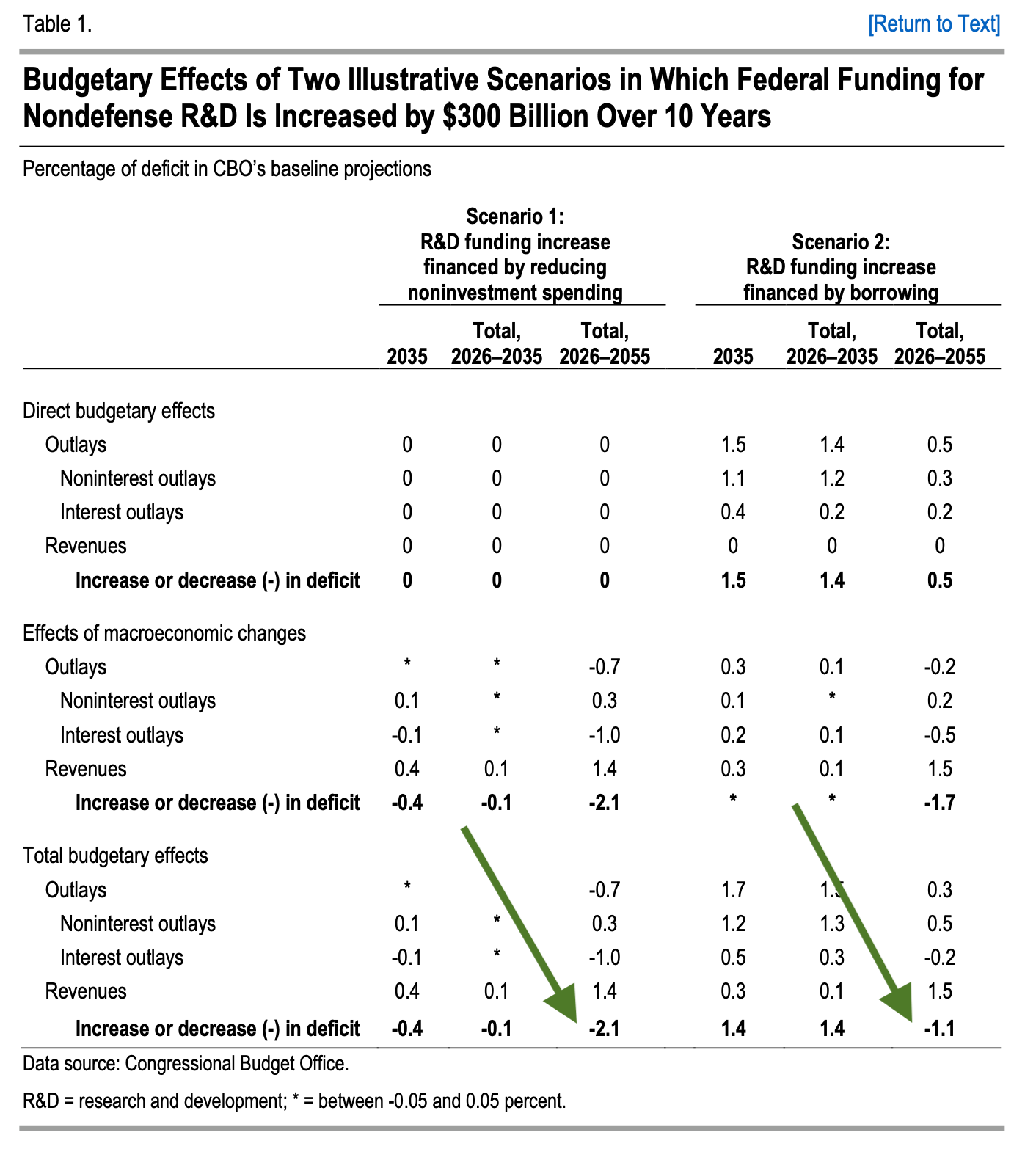
This means that the increased science funding would grow the economy so much that the tax revenues received from this growth alone would outweigh the spending increase, leading to an overall decrease in the budget deficit. In other words, increasing science funding (at least by this amount) is a complete no-brainer, so let’s do it already!
A few years ago the CBO did a similar report for infrastructure spending and compared the two in this report, finding the ROI effects of science funding to be about seven times greater than infrastructure spending. Again, so let’s do it already!
The effect on the present value of GDP over the next 30 years (discounted using Treasury rates) that a dollar increase in deficit-financed R&D spending would have is about seven times larger than the effect that CBO, in its August 2021 report, estimated the same increase in infrastructure spending would have.
Second, the Clark Center regularly polls a panel of economists, and recently they asked about this specific topic. The panel essentially universally agreed that historically U.S. science funding has paid for itself. In particular, 82% agreed “historical federal support for scientific research has paid for itself through a substantial positive effect on long-run U.S. productivity growth.” 0% disagreed, with the rest either not answering, or declaring either “no opinion” or “uncertain”. They also ask respondents about the confidence in their answer, and when weighted the results are even more striking with a whopping 97% in the agree category.
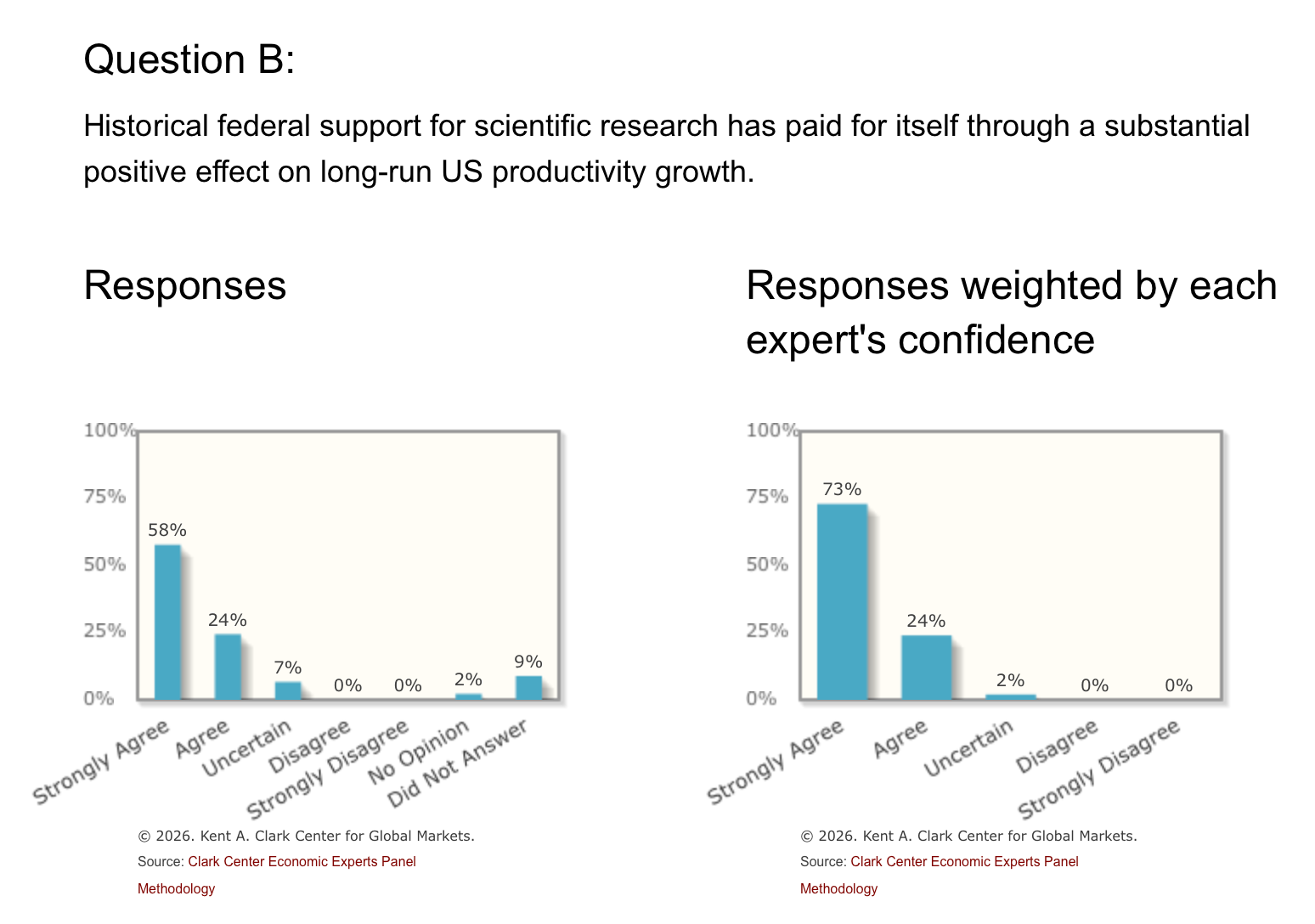
Are you sold yet? Government science funding, the bulk of which goes to medical research, extends our lifespans and healthspans by inventing new medicines and other technologies that grow our economy so much it literally pays for itself. I get that this is not the most flashy policy area, but it is the most obviously good for our long-term future.
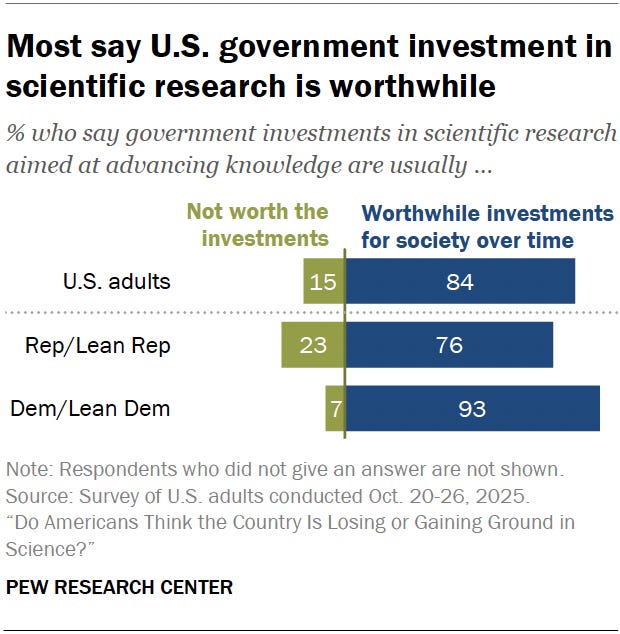
Finally, and also new this year, the Pew Research Center put out a survey on Americans’ views of science and science funding, and among other things found broad bipartisan support for government science funding. 84% of U.S. adults say “government investments in scientific research aimed at advancing knowledge are usually worthwhile investments for society over time.” That breaks down by part as 76% of Republicans and 93% of Democrats (including independents who lean one way or the other).
Great piece. Readers of Risk & Progress know that science spending is pretty much the only area where I would advocate spending more.
Human progress is a function of knowledge accumulation and energy capture. The non-rival nature of knowledge means that the free market underinvestments in the creation of knowledge.
Where the free market fails, our sovereign leviathans should step in.
No-brainer is appropriate, but a poor choice of words. The biggest impediment in the US is a president lacking a brain, and the Neanderthals that support him, in the administration and the public.