

I try hard not to lie, but would I lie to save my family from being murdered? Of course. In that case honesty loses to protecting my family. Principles almost always have exceptions, often when they conflict with other principles (which I’m calling Rule 5 in this rules series).
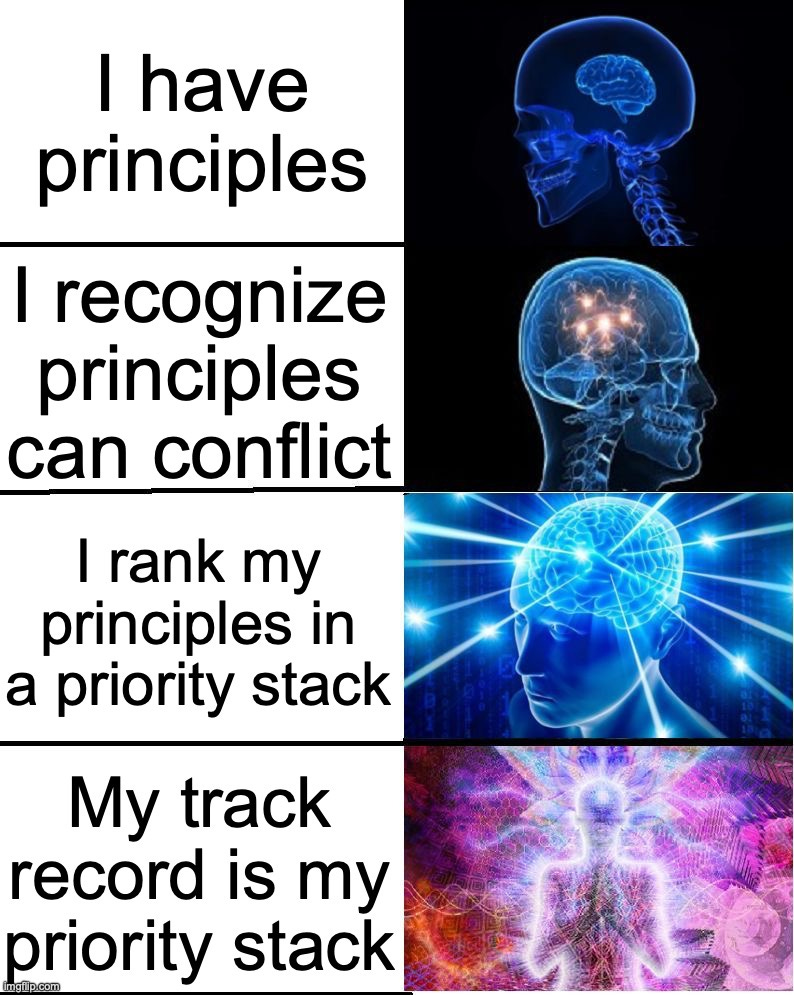
This rule follows from Rule 1: Reality is always more complicated. Put another way, there are always edge cases. Often edge cases between principles (personal or otherwise) get resolved via a principle priority stack, an implicit or explicit hierarchy of principles. An example is Isaac Asimov’s Three Laws of Robotics:
First Law: A robot may not injure a human being or, through inaction, allow a human being to come to harm.
Second Law: A robot must obey the orders given it by human beings except where such orders would conflict with the First Law.
Third Law: A robot must protect its own existence as long as such protection does not conflict with the First or Second Law.
Asimov spent much of his robot fiction dissecting situations where these “Laws” explicitly conflict or otherwise get subverted by edge cases. While these are make-believe situations, the priority stack mental model explains a lot of otherwise seemingly irrational behavior in the real world.
For example, why do politicians and political parties seem to flip-flop on supposedly strongly held principles? I do not think in all cases it is because they actually don’t have strongly held principles, but that there is something higher up in their principle priority stack, usually winning elections.
The same is true with corporations, especially public ones. Most have profits (or a similar financial metric) at the top of their principle priority stack, above other customer-focused principles like sound privacy practices, good service, etc. Some corporations have it the other way around, like DuckDuckGo where we’ve forgone a lot of profits because privacy is higher on our principle priority stack, or some B corps with other elevated non-financial priorities.
The priority stack model itself has edge cases! A given priority stack holds under normal conditions, but extreme conditions can reshuffle the ranking. For example, politicians do occasionally reach a breaking point where a usually lower principle (to winning elections) is about to be violated badly enough that they temporarily elevate it to the top, accepting re-election risk as a result. It’s rare, but it does happen.
What can you practically do with this Rule? I think at least two things. First, when thinking about principles, either your own or others’, you can ask how they arrange in a priority stack, especially relative to a given situation you are facing or are concerned with facing in the future. This arrangement can help clarify what you or others would actually do.
Second, if you’d like to convey that you care about a particular principle, I think it helps to publicly signal it in a priority stack context, at least against one other perceived high priority. For example, I'd love to vote for politicians who name a few principles they hold higher than re-election, such that they publicly commit to voting for those principles regardless of future electoral consequences. You can't fully predict or trust the future, but a stated priority stack is more trustworthy than silence, and more trustworthy still when there's a track record behind it.
The Dark Knight (2008).