

The so-called “privacy paradox” states that people say they value their privacy while acting in ways that don't reflect this stated preference, such as using services that collect and monetize their data. DuckDuckGo is often held out as an example in this way: DuckDuckGo has small search marketshare relative to Google; therefore, people have a revealed preference that they really don’t value their privacy.
I believe there are two flaws with this view that I’ll expand on below:
DuckDuckGo is a bad example because of particulars in the search market; Apple’s “Allow App to Track” dialog (depicted below) is a much better example that in fact shows a clear revealed preference for privacy.
People sit on a continuum of privacy preferences, such that it is way too simplistic to imply nearly everyone is on one side or the other. Gross generalizations about privacy should be avoided.
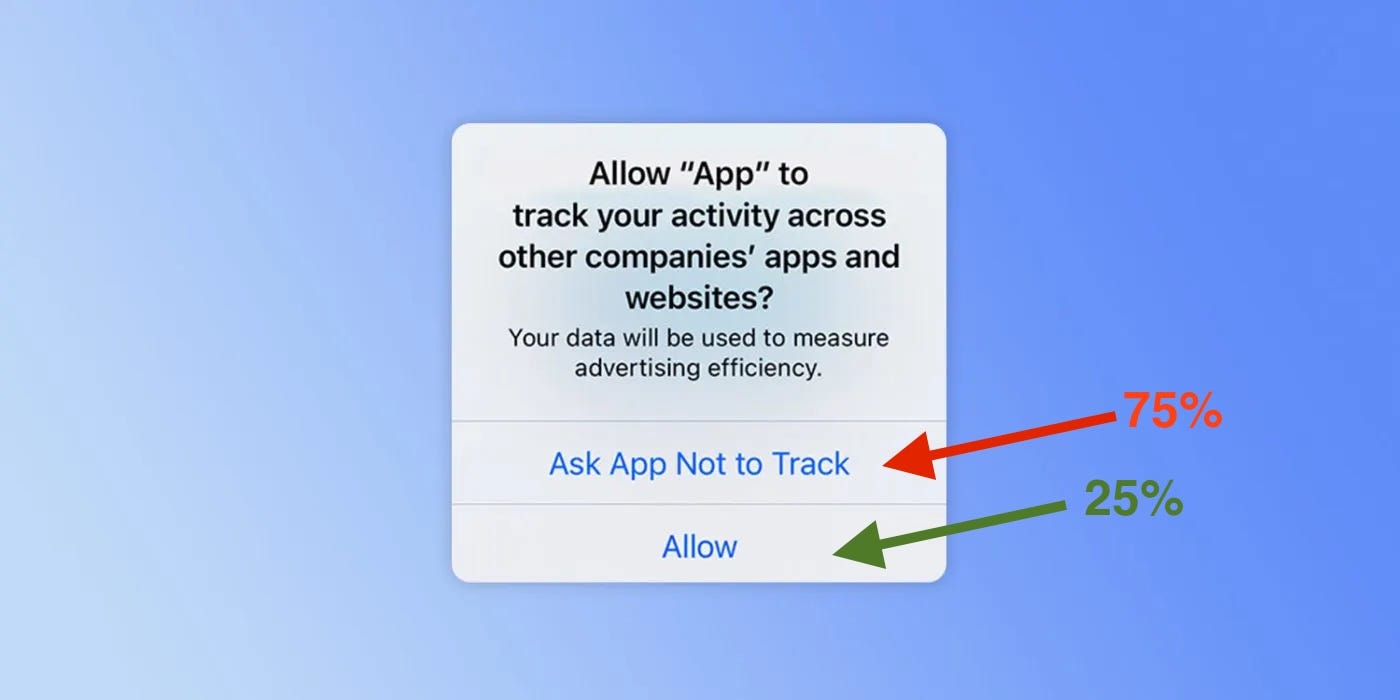
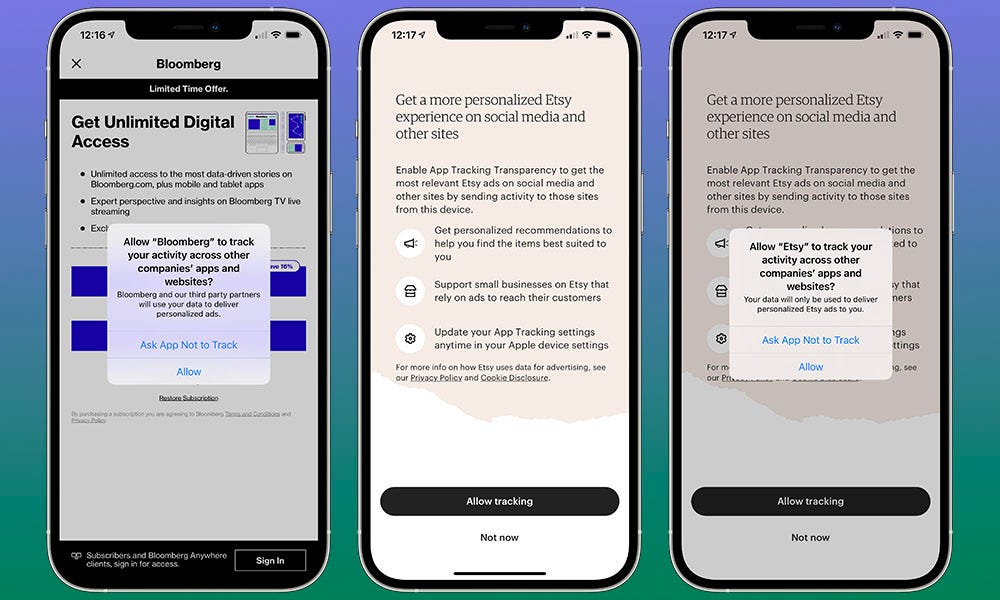
The latest U.S. data from the Business of Apps shows an opt-in (allow tracking) rate on Apple’s dialog of 25%, indicating a 75% strong revealed preference for privacy. This 25% allow-tracking rate is higher than the original 5-10% rates reported when the dialog first came out because both users have had years to get used to it and apps have had years to change their UIs around. Apps now often present users with the best reasons to allow tracking, usually presented right before users see the dialog, and they can customize the explanation text in the dialog itself (see below for examples). That is, I don’t think you can legitimately say anymore that people don’t understand the dialog or the privacy tradeoffs involved; the 25% steady state is the real preference.
But, how do you reconcile this 75% choice for privacy with DuckDuckGo’s 3% search marketshare? The short version is most people are actually still unaware of DuckDuckGo and, for those that are and want to make the switch, many still find it difficult or impossible to do so across all platforms and devices because, unlike with the Apple one-click dialog, users are not universally presented with a similarly clear one-click search choice screen.
To unpack that a bit more, here’s the awareness and usage of DuckDuckGo data for the American public, based on our latest commissioned brand study:
13% current DuckDuckGo users
9% past DuckDuckGo users
30% aided privacy awareness (can identify DuckDuckGo as offering online privacy services from a list of companies)
2% unaided privacy awareness (can name DuckDuckGo as a company offering online privacy services when asked to name companies in this category they can recall)
These numbers show our marketshare substantially depressed in a number of ways. First, we have 3% search marketshare in the U.S., but another 10 percentage points of users self-identifying as current DuckDuckGo users. We also ask about particular usage and find that’s because most DuckDuckGo users are either not full-time users or not full-time users on all their devices, or both. Reasons vary but are a combination of:
Didn’t know we had products (or could switch) on all platforms
Couldn’t figure out how to switch on all platforms (or thought it was too difficult being so many steps)
Technically they can’t fully switch on all platforms (like on Android)
They like to multi-home
Perceived quality issues
No choice was ever given to them (Google locking up all the defaults)
New devices reverting (back to those defaults)
Other Google monopoly tactics (like confusing switch-back notices on Chrome).
Breaking decade-long habits is just hard
Second, there is the 9% of past DuckDuckGo users who are no longer active users for all the same reasons, giving up on us after some period of time. We’ve been a search engine for almost 18 years. We’ve gotten a lot better over time, but maybe we weren’t good enough for them when they tried us out last, or they couldn’t overcome Google’s tactics, etc. etc. (If you’re in this group by the way, please consider giving us another shot!)
And third, awareness of who we are and what we do is still very low. 2% unaided privacy awareness is tiny. 30% aided privacy awareness is OK but that means people had to be presented with the name DuckDuckGo, and even then not all of them could articulate that we even run a private search engine, just that we have something to do with privacy. Let alone the fact that awareness of Google’s many privacy issues also isn’t that high.
In other words, if you’re going to make a revealed preference argument about privacy, it is silly to anchor on our search marketshare (with all the enumerated issues above) and ignore Apple’s dialog since the latter is a much, much cleaner articulation of a privacy choice actually presented directly to users. A more equivalent search engine test would be if Google launched a similarly required one-click dialog box asking if people would like Google to continue tracking them or not. I would suppose Google would get similar allow-tracking rates as apps get on Apple’s platform, with a solid majority choosing privacy.
These nuances expose a major flaw that revealed-preference arguments often have: Any preference is situationally specific, depending on a variety of factors, such as how a choice is presented, if a choice is proactively presented at all, the risks/tradeoffs involved, and switching costs (perceived and real). The more proactive and clear the choice, the more it will capture real preferences, which is why the Apple dialog is particularly revealing.
Now, on top of all this, the tech press tends to downplay or outright ignore preference groups that constitute a minority percentage, even if that group is actually quite large, say 20% of the population. 20% amounts to about 50 million U.S. adults and is also about the proportion that are either current or past DuckDuckGo users. If 80% use x, that often translates to “nearly everybody uses x” with the remaining people considered niche. For pervasive services like search, that’s quite a niche! Most any product would love tens of millions of users.
Taken together with the revealed preference issue, the tech press therefore routinely understates the actual preference for privacy in general, and the interest in DuckDuckGo products in particular. Due to Big Tech monopolies, I continue to believe there is large, pent up demand for privacy services online, which Apple’s dialog suggests.
I have used DuckDuckGo for many years, almost from the beginning. Like everyone else, I used Google when it first came out; it was new, simple, and focused on search, not data mining. Things changed with Google becoming a sales agent, not a search engine, and I have not even opened a Google search block in years, nor will I.
Really useful framing, and I think it understates your own case.
Every privacy choice anyone has ever been handed is a choice to give something up. Block, decline, opt out, ask an app not to track. Apple's dialog is the cleanest version of that and it still asks a person to accept a cost and get nothing back. Holding 75 percent on those terms is not the ceiling of the preference. That is the preference surviving a bad deal.
The other test has not been run yet. Nobody has been shown a choice where keeping your own data is the option that pays you.
Same shape as your switching cost list, one level down. People have had a legal right to take their data back for years now, in Europe and in a growing number of US states, and there has still been nowhere to put it. No destination, no choice presented, nothing to measure.
Privacy is where this starts. Data Ownership is the part nobody has built yet.